We were told solar panels were the future—but not that a silver layer 1,000 times thinner than a human hair could make them dramatically more powerful
Organic solar cells have long promised a cheaper, more flexible path to clean energy — but converting sunlight efficiently enough to matter has kept them trailing far behind silicon. That gap just got a lot. . .
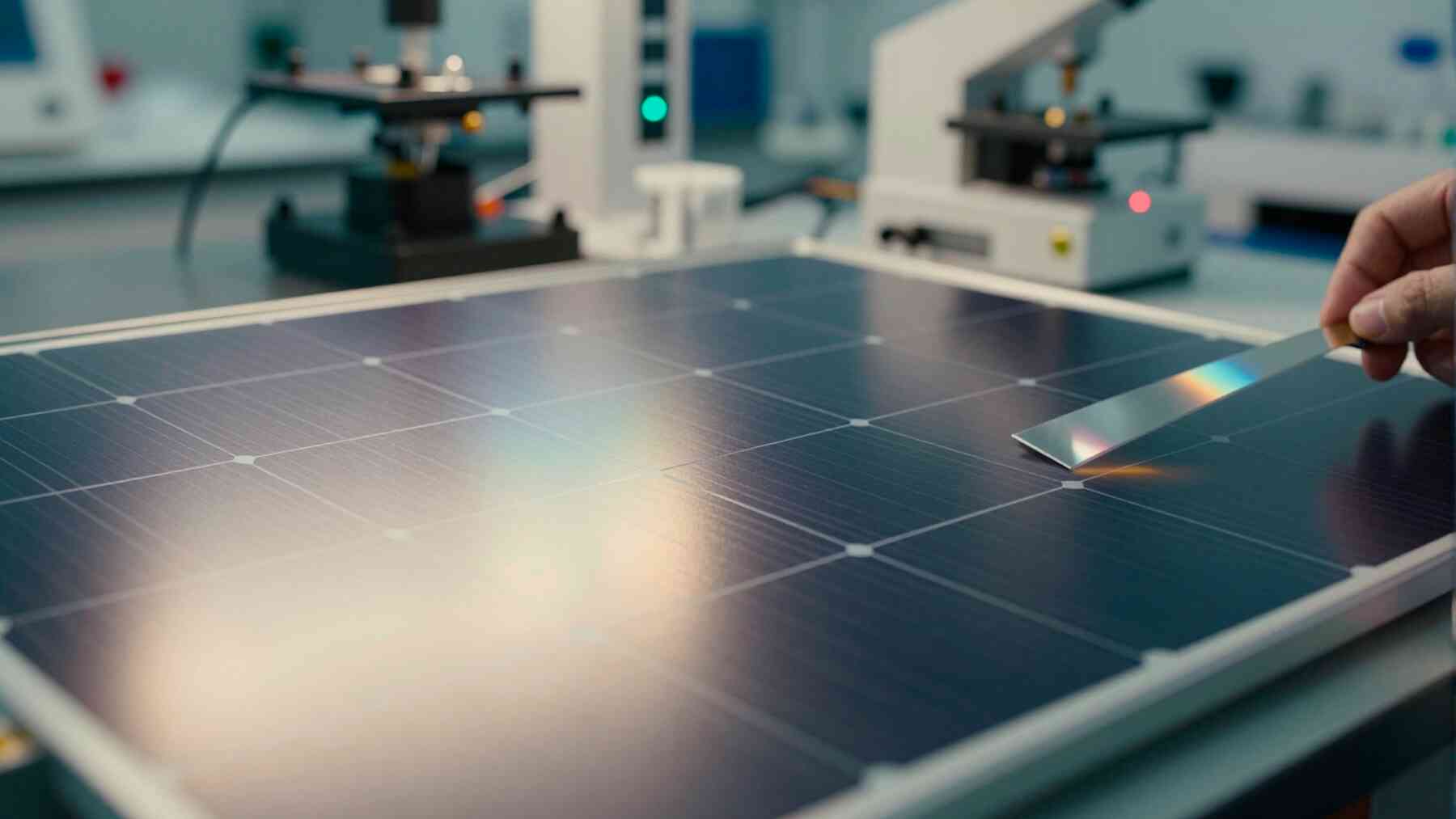
Organic solar cells have long promised a cheaper, more flexible path to clean energy — but converting sunlight efficiently enough to matter has kept them trailing far behind silicon. That gap just got a lot narrower. Researchers at ICFO in Barcelona have announced a four-terminal tandem organic solar cell that reached 16. 94% power conversion efficiency — compared to a last reported benchmark of 6. 5% for the same cell type. At the center of the breakthrough is a silver electrode just 7 nanometers thick,roughly 1,000 times thinner than a human hair. Why organic solar cells keep falling shortOrganic solar cells are built from carbon-based materials rather than crystalline silicon. They can be made flexible, lightweight, and potentially far cheaper to manufacture than conventional panels — printable onto surfaces, embeddable in windows, or layered onto curved structures in ways silicon simply can’t match. Efficiency remains the stubborn problem. A single-junction organic solar cell can only absorb a slice of the solar spectrum. Photons carrying too much energy shed the excess as heat — thermalization loss. Those with too little energy pass straight through — transmission loss. Together, these two mechanisms impose a hard ceiling onhow much power any single cell can extract from sunlight. Tandem configurations address this directly by stacking two subcells with different bandgaps, each tuned to a different part of the spectrum. More photons get captured; more energy becomes electricity. It’s a solution already proven in silicon and perovskite devices. Two-terminal organic tandems are notoriously difficult to build, though. The subcells share a single electrical circuit, so their currents must be precisely matched. The interconnection layer between them has to be both electrically efficient and highly transparent —a combination that’s genuinely hard to pull off. A different approach: four terminals instead of twoThe four-terminal design sidesteps the current-matching problem entirely. Front and rear subcells have separate electrical connections and operate independently, so researchers can choose each subcell’s bandgap based purely on optimal light absorption rather than circuit constraints. That theoretical advantage hadn’t translated into results. The last reported efficiency for this cell type sat at just 6. 5%, and the official record across all organic tandem devices — including two-terminal designs — stood at 14. 2%. The ICFO team set out to close that gap. Building the cell: materials, math, and a razor-thin electrodeFor the front cell, the researchers selected PM6:L8-BO as the best-performing photoactive blend. The back cell, designed to absorb infrared photons, used PTB7-Th:O6T-4F — a narrow-bandgap blendwell suited to that part of the spectrum. Before fabricating anything, the team ran matrix formalism combined with inverse problem-solving to determine the optimal device structure computationally. The central fabrication challenge was the front cell’s top electrode. Conventional transparent silver electrodes run between 9 and 15 nm thick; the ICFO team pushed that down to 7 nm. That7 nm silver layerwas integrated into a photonic multilayer stack alternating tungsten trioxide (WO₃) and lithium fluoride (LiF). The structure delivers high transmission in the 750–1000 nm range — letting infrared light reach the back cell — while reflecting light in the 500–700 nm range back toward the front cell, recovering energy that would otherwise be lost. Record efficiency — and what the numbers meanTested under 1 sun illumination using a solar simulator, with quantum efficiency measurements also conducted, the device achieved 16. 94% power conversion efficiency. That surpasses the previous official organic tandem record of 14. 2%, a benchmark covering all organic tandem architectures. Against the last reported four-terminal result of 6. 5%, the improvement is more than twofold. Francisco Bernal, first author of the study, pointed to the electrode as the linchpin. “Being able to fabricate an electrode of only 7nm without observing losses in the front transparent cells is a significant advancement in the field of transparent cells,” he said. At 7 nm, that balance between transparency and conductivity hadn’t previously been demonstrated without penalty. Beyond solar panels: fuel, CO₂, and what comes nextThe ICFO team isn’t thinking only about rooftop panels. Prof. Jordi Martorell, who coordinated the research, pointed to photoelectrochemical cells as a key application target — devices that use solar energy tosplit water into hydrogen or convert CO₂ into useful fuels,including within the SOREC2 project framework. Martorell emphasized that the methodology itself is the transferable asset. “The methodology for the design and implementation of the four-terminal tandem structure could be applied to design new systems where an adequate distribution of light in the elements is crucial for the performance of a certain device,” he explained. The team is currently focused on refining that methodology for solar fuel applications, including CO₂ conversion and valorization. Author ProfileCarlosCarlos is an engineer with strong expertise in technical and industrial topics. He previously worked at international companies such as Siemens and speaks Spanish, German, English, and Italian.