Ethereum Leads Weekly Bridge Inflows as Arbitrum Posts $105 Million Outflow - TokenPost
Ethereum (ETH) led weekly net bridge inflows among major blockchains, posting a $64. 73 million net gain, even as Arbitrum recorded the largest net outflow at $105. 48 million—signaling a fresh rotation of cross-chain. . .
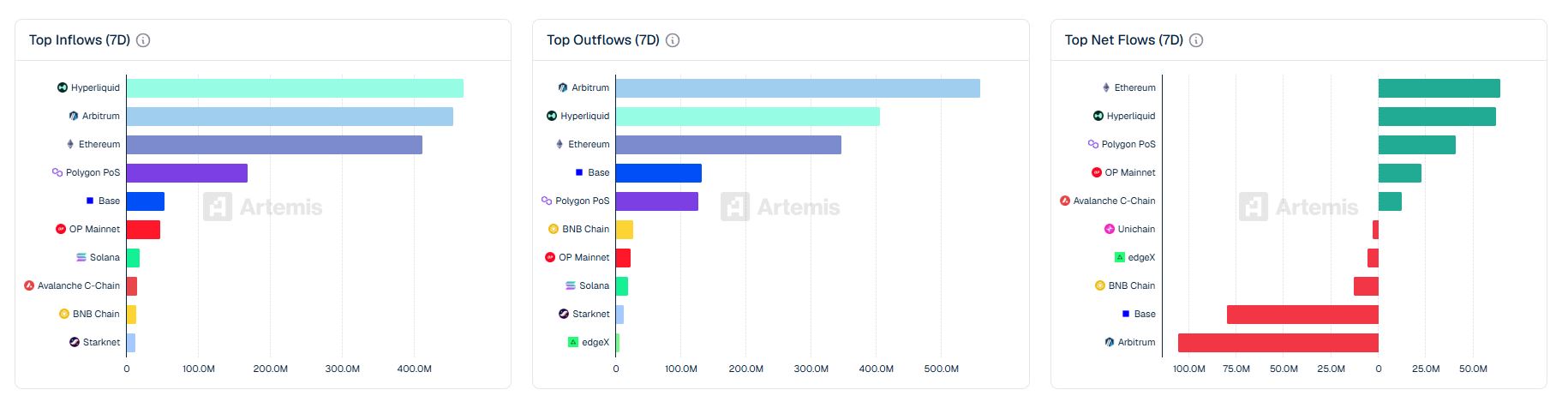
Ethereum (ETH) led weekly net bridge inflows among major blockchains, posting a $64. 73 million net gain, even as Arbitrum recorded the largest net outflow at $105. 48 million—signaling a fresh rotation of cross-chain liquidity rather than a one-way risk-on move. According to data published by crypto analytics platform Artemis on June 24 UTC, bridge flows over the past week showed heavy two-way movement across several ecosystems. In gross inflows, Hyperliquid attracted the most bridged assets at $469. 71 million, followed by Arbitrum at $454. 92 million and Ethereum at $411. 69 million. Polygon PoS brought in $168. 73 million and Base added $53. 24 million, while smaller but notable inflows were recorded on OP Mainnet ($47. 14 million), Solana (SOL) ($19. 07 million), Avalanche C-Chain (AVAX) ($15. 76 million), BNB Chain ($14. 70 million), and Starknet ($13. 49 million). On the outflow side, Arbitrum also saw the largest gross withdrawals at $560. 40 million, underscoring its role as a high-velocity hub for bridging activity. Hyperliquid followed with $407. 27 million in outflows, while Ethereum saw $346. 96 million exit over the same period. Base recorded $132. 72 million in outflows and Polygon PoS $127. 71 million. Additional outflows were observed from BNB Chain ($27. 46 million), OP Mainnet ($24. 30 million), Solana ($19. 63 million), Starknet ($13. 44 million), and edgeX ($6. 38 million). Netting inflows against outflows, Ethereum emerged as the top destination for 'net liquidity inflow' with $64. 73 million, edging out Hyperliquid at $62. 43 million. Polygon PoS followed with a $41. 02 million net inflow, while OP Mainnet added $22. 85 million and Avalanche C-Chain gained $12. 50 million. Arbitrum posted the largest 'net liquidity outflow' at $105. 48 million, suggesting capital may have been redeployed to other chains or temporarily moved off-bridge into alternative venues. Base recorded a $79. 48 million net outflow, while BNB Chain saw $12. 76 million. Smaller net outflows were also reported for edgeX ($5. 47 million) and Unichain ($2. 64 million). Market observers often treat bridge flows as a proxy for where traders are positioning liquidity for on-chain activity—such as lending, perpetuals trading, or ecosystem-specific incentive programs—though the data can also reflect short-term arbitrage and operational rebalancing by large accounts. The latest figures point to continued fragmentation of on-chain liquidity, with Ethereum maintaining a net advantage as a settlement layer while high-throughput environments like Arbitrum and Base show signs of churn. Overall, the week’s bridge activity highlights a market still actively reallocating capital across ecosystems. If net inflows into Ethereum persist, it could reinforce its role as the primary liquidity anchor, while sustained net outflows from certain Layer-2s may indicate shifting demand for specific trading venues, yields, or applications. Article Summary by TokenPost. ai🔎 Market InterpretationEthereum led net bridge inflows: ETH recorded+$64. 73M net, narrowly ahead of Hyperliquid (+$62. 43M), suggesting Ethereum remains a preferred settlement/liquidity destination despite large two-way flows. Rotation, not pure risk-on: Arbitrum had the largestnet outflow (-$105. 48M)even while ranking near the top in gross inflows and outflows, indicatinghigh churn and redistributionrather than a single-direction market bet. Bridging hubs show velocity: Arbitrum’s$454. 92M gross inflowsand$560. 40M gross outflowshighlight its role as an active routing venue where liquidity frequently transits rather than accumulates. Selective accumulation across chains: Polygon PoS (+$41. 02M), OP Mainnet (+$22. 85M), and Avalanche C-Chain (+$12. 50M) posted positive net inflows, pointing totargeted deployments(apps, incentives, or positioning) beyond Ethereum alone. Layer-2 churn signals venue switching: Base posted a sizablenet outflow (-$79. 48M), aligning with the article’s view that some high-throughput environments are seeingliquidity turnoveras traders chase better yields, depth, or product fit. Liquidity fragmentation persists: The distribution of inflows/outflows across many ecosystems supports a market structure where capital iscontinuously rebalancedacross chains for tactics like arbitrage, lending, and perpetuals. 💡 Strategic PointsTrack net flows, not just gross: High gross bridge activity can mask whether a chain isaccumulatingor merelyroutingliquidity. Net flow is the clearer signal for positioning. Ethereum as “liquidity anchor” watch: If ETH maintains consistent net inflows, it may reinforce Ethereum’s role as theprimary settlement layerwhere capital ultimately consolidates for safety, collateral usage, and deep DeFi liquidity. Arbitrum/Base: interpret outflows carefully: Net outflows can reflectprofit-taking, incentive cycling, venue migration,oroperational rebalancingby large accounts—not necessarily bearish fundamentals. Hyperliquid strength is two-sided: Leading gross inflows ($469. 71M) alongside strong net inflow suggests durable demand, but large outflows implytactical usage(e. g. , perps/liquidity provisioning) that can reverse quickly. Use flows to anticipate on-chain activity: Sustained net inflows often precede increased usage inlending, perps, and incentive programs; monitor whether net-positive chains see rising TVL/volume as follow-through confirmation. Risk management: Rapid cross-chain rotations increase exposure tobridge risk, latency, and slippage. Favor robust routes, consider splitting transfers, and avoid bridging during volatility spikes. 📘 GlossaryBridge flows: Movements of crypto assets between blockchains via bridges; used as a proxy for liquidity migration. Gross inflow / gross outflow: Total value bridged into / out of a chain over a period, regardless of direction elsewhere. Net flow (net inflow/outflow): Gross inflows minus gross outflows; indicates whether liquidityaccumulatedon a chain orleftit. Liquidity rotation: Capital moving among ecosystems to pursue better yields, incentives, liquidity depth, or trading opportunities. Settlement layer: A base network where assets are ultimately held/settled, often due to perceived security and deep liquidity (e. g. , Ethereum). Layer-2 (L2): Scaling networks built on top of a Layer-1 (like Ethereum) to improve throughput and reduce fees (e. g. , Arbitrum, Base, OP Mainnet). Churn: High turnover of liquidity—large inflows and outflows with limited net change—often signaling short-term trading or routing behavior. Arbitrage: Exploiting price differences across venues/chains; can generate bridge traffic without indicating long-term allocation.