Bitcoin trades 24/7 and still keeps New York office hours for BINANCE:BTCUSDT by nonsanchart
Crypto never closes. Everyone repeats this. So I took 1000 hours of BTC — about 42 days — and sorted every hourly candle into 24 buckets by hour of the UTC day, then averaged the range of each bucket. If the market were genuinely borderless and always-on, those 24 numbers should look roughly alike. They do not. Busiest hour: 14:00 UTC, average range 0. 342% Quietest hour: 20:00 UTC, average range 0. 115% Three times apart. And the specific hours are the point. 14:00 UTC is 10am in New York. …
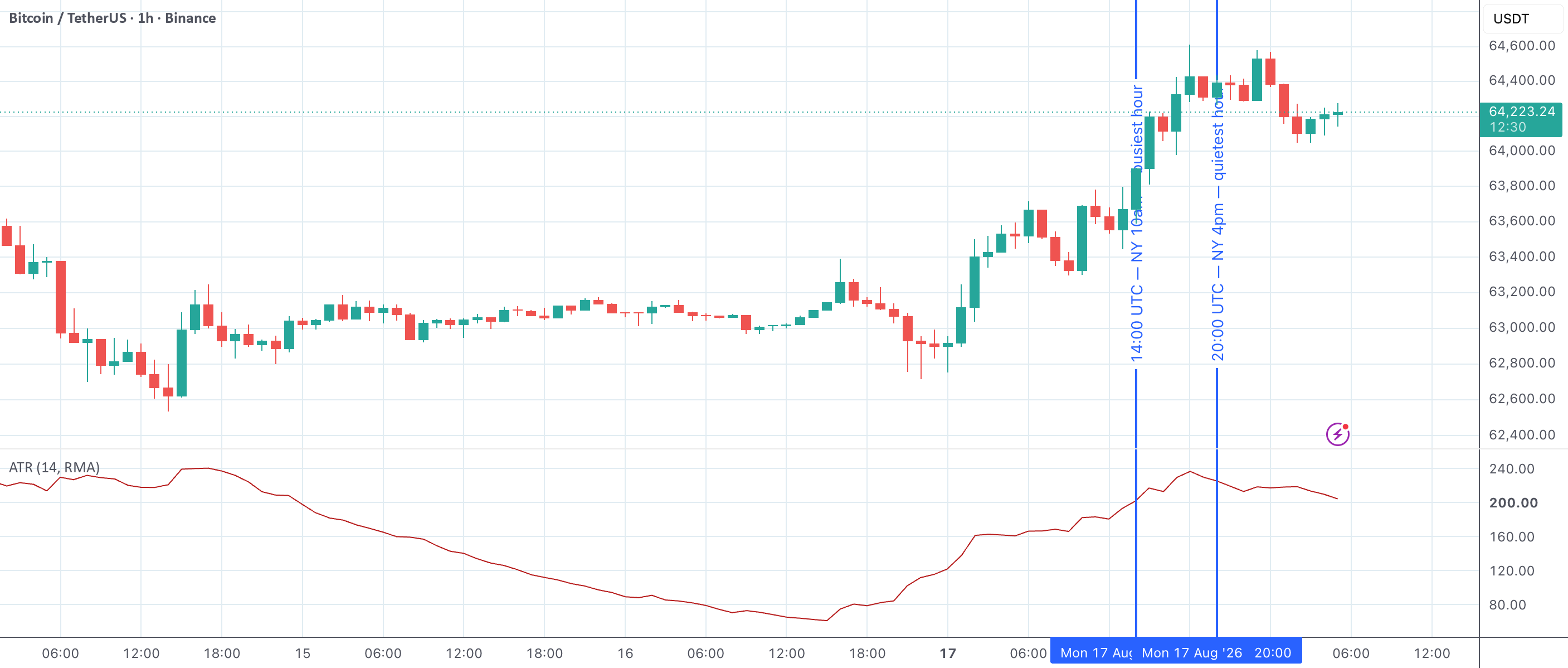
Crypto never closes. Everyone repeats this. So I took 1000 hours of BTC — about 42 days — and sorted every hourly candle into 24 buckets by hour of the UTC day, then averaged the range of each bucket. If the market were genuinely borderless and always-on, those 24 numbers should look roughly alike. They do not. Busiest hour: 14:00 UTC, average range 0. 342%Quietest hour: 20:00 UTC, average range 0. 115%Three times apart. And the specific hours are the point. 14:00 UTC is 10am in New York. 20:00 UTC is 4pm in New York, the minute the NYSE closing bell rings. The two vertical lines on the chart mark exactly those hours on Aug 17. The most decentralised market on earth is at its loudest when Wall Street sits down and at its quietest when Wall Street goes home. THREE HUMPS, NOT ONESort the full 24 and the shape has three bumps rather than one:01:00 UTC — 0. 290% — Tokyo and Seoul mid-morning08:00 UTC — 0. 212% — London open13:00 to 15:00 UTC — 0. 280 / 0. 301 / 0. 342% — New York morningThat is the map of global finance drawn by a market that supposedly does not care about any of it. Volume tells the same story: about 61M per hour at 14:00 UTC against 20M at 21:00 UTC. WHY IT ACTUALLY MATTERSThree practical consequences, none of them exotic. Your stop is not equally safe at every hour. A stop that is comfortably outside noise at 03:00 UTC sits inside noise at 14:00 UTC, because noise is three times larger there. Same distance, different risk. A breakout at 20:00 UTC and a breakout at 14:00 UTC are not the same event. One happened in the thinnest liquidity of the day. The other happened while the largest pool of participants was awake and paying attention. Comparing either against a flat 24-hour average blurs the difference. If you only trade one part of the day, your sense of "normal volatility" is calibrated to that slice and nowhere else. Two traders can disagree about whether a move was big and both be right, because they live in different hours. HOW TO CHECK IT YOURSELFPull hourly bars for whatever you trade. Group by hour of day. Average the range in each group. Twenty-four numbers. Do it for an instrument with a real exchange session and you will see the session. Do it for crypto and you will see New York wearing a costume. I have no idea where price goes next and this says nothing about direction. It is a statement about when the market is awake. Not financial advice. DisclaimerThe information and publications are not meant to be, and do not constitute, financial, investment, trading, or other types of advice or recommendations supplied or endorsed by TradingView. Read more in theTerms of Use.