Bitcoin August: Why My Favorite Month Is Bitcoin's Worst - Airdrop Alert
August is my favorite time of the year. Family and friends finally get their vacation from work, and summer is in full force. My days fill up with family time around the pool and backyard barbecues three times a week. Everyone is in a good mood. Well, almost everyone. One thing is historically not in a […]
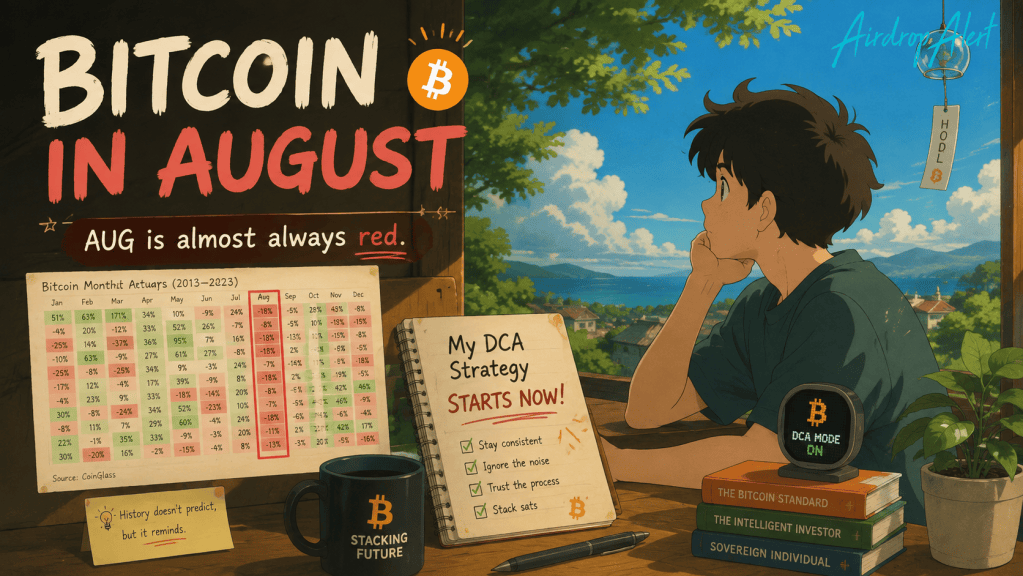
August is my favorite time of the year. Family and friends finally get their vacation from work, and summer is in full force. My days fill up with family time around the pool and backyard barbecues three times a week. Everyone is in a good mood. Well, almost everyone. One thing is historicallynotin a good mood in August, and that’s Bitcoin. While the rest of us are flipping burgers, Bitcoin has a habit of flipping red. In this post, we’ll dig into the historical Bitcoin August numbers, why midterm years make it even trickier, and exactly how I’m using this weak season to build positions with a DCA plan that runs into November. Bitcoin in August: The Historical NumbersBitcoin August Returns CoinglassLet’s start with the data, because the pattern is hard to ignore. Since 2013,Bitcoinhas closed August in the red 9 out of 13 times. Only four Augusts finished green in that entire stretch: 2013, 2017, 2020, and 2021. On top of that, the recent streak is brutal. Every single August from 2022 through 2025 closed red, with losses ranging from -6. 5% to -13. 9%. Now, if you look at theaverageAugust return, it shows a small positive number of around +1%. Don’t let that fool you. That average is carried by the two outlier Augusts of 2013 (+30%) and 2017 (+65%). The median tells the honest story: roughly-7%. In other words, the typical August takes about seven percent off your stack. And here’s the kicker for 2026: midterm years. Every midterm-year August on record has closed red, and mostly down bad:August 2014:-17. 55%August 2018:-9. 27%August 2022:-13. 88%Three for three. Yes, that’s a small sample size, so I won’t pretend it’s a law of nature. Still, when the seasonal pattern and the midterm pattern point the same direction, I pay attention. And 2026 is, you guessed it, a midterm year. Wait, What Are Midterms?For readers outside the US: midterm elections happen halfway through a presidential term. In November 2026, Americans vote on the entire House of Representatives and a third of the Senate. Why does Bitcoin care? Because markets hate uncertainty, and midterms create plenty of it. Control of Congress can flip, and with it the outlook on regulation, taxes, and spending. Crypto is more politically charged than ever, so a shift in Washington can genuinely move the market’s mood. Nobody knows the outcome until the votes are counted. Until then, big money tends to sit on its hands, and that insecurity hangs over the market all through late summer and fall. Summer Means Thin MarketsThere’s a second, simpler reason August is rough: half the trading world is on a beach. Big money is enjoying vacations too. Trading desks run on skeleton crews, volumes dry up, and liquidity gets thin. Thin liquidity means bigger wicks, sharper liquidation cascades, and generally more fuckery. A market that would shrug off a $200 million sell order in October can get slammed by it in August. Add in a surprise macro headline or a hawkish Fed meeting, and things get messy fast — we saw exactly how that plays out whenFOMC days wreck overleveraged longs. Yes, there will be some runners, and we keep a close eye on the trends. But drawingsupport and resistance lineson charts of 10 coins every morning? That’s not me in August. I’d rather be in the pool with the kids than trying to scalp a tough, illiquid market. So instead of trading harder, I’m doing the opposite. I’m putting my buying on autopilot. Support Our WorkIf you found this helpful, consider signing up onOKXorBybitusing our referral links. Your support keeps this content free and flowing. My DCA Starts NowHere’s the part you can actually use. Weak season, thin liquidity, and midterm uncertainty add up to one thing for me: accumulation territory. I’ve got myDCAorders in, and the plan has two halves. Half one: price-based ordersFor Bitcoin, my limit orders are laddered from$54,000 down to $38,000. This bucket holds around 50% of what I want to buy in total. To be clear, I’m not saying we go all the way down to $38k. But if we get a violent wick down there during some thin August liquidity, I want to get filled while everyone else is panicking. That’s the whole point of setting orders in advance — nobody rings a bell at the bottom, andbottoms rarely look like bottomswhile they’re forming. Half two: time-based buysMy time-based DCA starts onAugust 14th. Why start buying if I expect more downside? Simple: I could be wrong about the bottom. If the recovery move starts earlier than I think, I don’t want to miss the first leg of it while sitting on my hands waiting for lower prices. From then on, I buy twice a week at a set time, all the way toNovember 7th. That works out to roughly 25 buy moments. The other 50% of my budget goes here. Each buy is 2% of my total target, so I’m deploying about 4% per week, rain or shine, green candle or red. Notice the end date. November 7th lands right after the midterm elections. By then, I want my full budget allocated. So if price never comes anywhere near $38k and my lower limit orders don’t fill, I’ll roll that leftover budget into the time-based buys instead. Hopefully, between now and November 7th, I’ll end up with a nice average Bitcoin buy price somewhere between$46,000 and $52,000. That’s a hope, not a prediction. The structure guarantees I get filled either way; the market decides the average. I’m running similar DCA strategies on a smaller scale for a few other coins, like SOL and HYPE. You can find my full shopping list in thebuying the crypto bottom list. Want my trade plans and market breakdowns in your inbox? Join thetrading newsletterand follow along as this DCA plays out. Final WordsBitcoin in August has a well-earned reputation: 9 red closes in 13 years, a median return around -7. 5%, and a perfect 3-for-3 red streak in midterm years. This year combines all of it — weak seasonality, vacation-thin liquidity, and election uncertainty stacked on top. You can fight that with a trading terminal and ten charts every morning. Or you can accept the season for what it is, set your orders, automate your buys, and go enjoy the barbecue. I know which one I’m choosing. See you at the pool. My limit orders will be working while I’m not. If you enjoyed this one, check out ourother trading content. As always, don’t forget to claim your bonus on Bybit EU below. See you next time!Check our recent review ofBybit vs Binance. FAQIs Bitcoin always down in August?No, but usually. Since 2013, August has closed red 9 out of 13 times, and every August from 2022 to 2025 was negative. Only 2013, 2020, and 2021 finished green. Why is August a bad month for Bitcoin?Two main reasons: summer liquidity is thin because institutional traders are on vacation, and the median August return sits around -7. 5%. Thin markets amplify volatility, so sell-offs hit harder. What happens to Bitcoin in midterm election years?So far, every midterm-year August (2014, 2018, 2022) closed red, with drops between roughly 9% and 17%. It’s a small sample size, but the pattern has been perfect so far. What is DCA in crypto?DCA (dollar-cost averaging) means buying a fixed amount at regular intervals instead of trying to time one perfect entry. It smooths out your average buy price and removes emotion from the process. When does Bitcoin usually recover after the summer?Historically, momentum tends to return in Q4. October and November have been two of Bitcoin’s strongest months on record, which is why accumulation during the August–September weakness can pay off. WRITTEN BYMorten ChristensenFounder, AirdropAlertCrypto class of '13, airdrop farmer since 2016. Avid trader and DeFi veteran. His market commentary has been featured by Bloomberg, The Wall Street Journal, The New York Times, Forbes, and CNN.