1inch Unveils Aqua to Pool DeFi Liquidity Across 13 Chains
1inchhas unveiledAqua, a new protocol designed to bring liquidity from multiple decentralized finance venues under one coordinated system. Announced this Tuesday, Aqua targets a recurring DeFi limitation:. . .
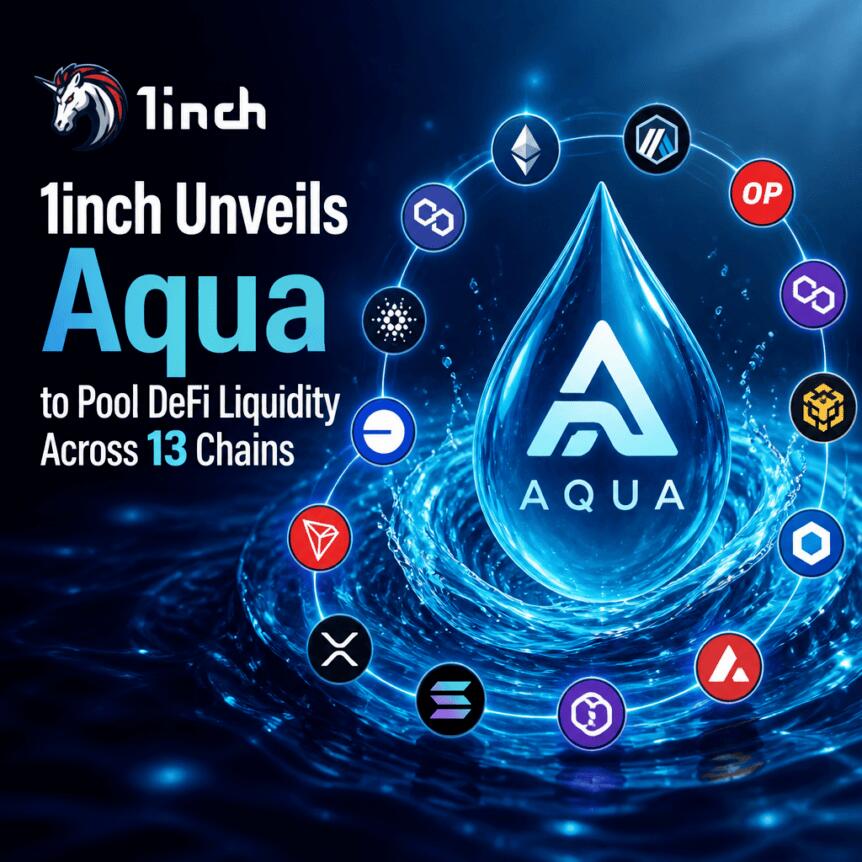
1inchhas unveiledAqua, a new protocol designed to bring liquidity from multiple decentralized finance venues under one coordinated system. Announced this Tuesday, Aqua targets a recurring DeFi limitation: liquidity is often fragmented by protocol, which can make routing less efficient and leave some pools underutilized. According to the1inchannouncement, Aqua works by letting liquidity providers authorize one or more strategies tied to a single wallet inventory. Rather than depositing assets permanently into any specific liquidity pool, the protocol keeps funds in the wallet until trades are settled, using atomic settlement to prevent overextension. Key takeawaysAqua aims to unify liquidity across many DeFi marketswithout locking assets into a single pool. Liquidity providers can authorize multiple strategieswhile assets remain in their wallet until settlement. Trades are constrained by available wallet balance; if a swap would exceed funds, it reverts atomically. 1inch plans to deploy Aqua across multiple chains, includingEthereumand several L2 and alternative networks. Pending governance approval, Aqua incentive funding is set to include USDC and 1INCH tokens. How Aqua coordinates liquidity without pool depositsAt the core of Aqua is an integrated toolkit that includes a generalized onchain registry, wallet-backed automated market making (AMM) strategies, atomic settlement, and position management that’s oriented around how liquidity is allocated to specific trades. The approach is meant to widen access to liquidity because it’s not necessarily bound to one protocol’s pool structure. That said, Aqua also does not allow unlimited parallel usage of the same capital. 1inch describes a model where the funds a provider makes available can participate in only one operation at a time, even if the provider is advertising liquidity across several venues. For example, the announcement illustrates a scenario where a liquidity provider with$10,000can advertise$10,000on three different protocols, potentially totaling$30,000of advertised positions. However, at any moment, only$10,000worth of simultaneous trades can actually execute from that inventory. The design effectively resembles coordinated “overbooking” of advertised capacity, but with strict balance checks at execution time. Atomic settlement and balance limits1inch provided additional detail through a spokesperson speaking toCointelegraph. The spokesperson noted that Aqua can be used byresolversholding a1inch-issued access credential, while not all protocols may be supported under the system. On execution mechanics, the spokesperson emphasized that Aqua positions are quoted against amarket maker’s live wallet balance. After a fill, any remaining position quotes against the remaining balance. If a swap request would exceed what’s actually available, the system should revert atomically, preventing partial execution or mismatched accounting. This “quote-to-balance” behavior is important for users and integrators because it helps reduce the risk of liquidity promises that can’t be honored at settlement—an issue that can arise in some routing and aggregation designs when inventory is handled off-contract or without tight execution constraints. Deployment footprint and onchain registrationIn its rollout plan, 1inch says Aqua has been deployed across13 blockchains, listing networks that includeEthereum,Arbitrum,Base,RobinhoodChain, andBNBChain. By spreading deployment across multiple ecosystems, Aqua is positioned as an infrastructure layer rather than a single-venue product. The protocol’s generalized onchain registry and wallet-backed strategy system are intended to make liquidity coordination more uniform across chains, while the atomic settlement model seeks to keep execution rules consistent even as liquidity sources vary by venue and chain. For liquidity providers and traders, the practical question is whether this architecture translates into better capital utilization and improved routing reliability. The “advertise more than you can simultaneously use” model only helps if demand patterns align—1inch’s design explicitly assumes that not all operations will require the same capital concurrently. Incentives pending governance voteSeparately, 1inch said that—subject to approval by tokenholders through apending governance vote—Aqua will receive incentives to support adoption. Under the proposal described in the announcement, the protocol would allocate500,000 USDCfor Aqua incentives, alongside10 million 1inch (1INCH)tokens. At the time of 1inch’s announcement, it stated that the token component was worth roughly$830,000. 1inch frames the incentive program as a way to accelerateliquidity growthandswap activityacross the pairs supported by Aqua. If approved, these incentives would align with Aqua’s thesis: coordinating inventory across venues should make it easier for participants to route and execute swaps using the aggregated wallet-backed liquidity. Investors and builders will likely watch whether the incentives increase actual swap throughput and whether liquidity providers continue to participate given the single-operation-at-a-time constraint. Background amid company leadership turmoilToday’s rollout comes after earlier reporting involving 1inch’s internal governance and management. Earlier in the month,Cointelegraphnoted that Anton Bukov, a co-founder of 1inch, said he was “fired” from the company in November 2025 after “pushing for change” in its management and operations, as described in coverage linked by Cointelegraph. While that dispute does not directly inform Aqua’s technical design, it adds context for readers tracking how 1inch’s roadmap is executed and how governance dynamics may influence future protocol decisions. With Aqua now deployed on 13 chains and incentives awaiting community approval, the next key signal will be whether wallet-backed coordination delivers measurable improvements in routing efficiency and swap volume—especially under real trading demand where simultaneous calls may compete for the same underlying inventory. Risk & affiliate notice:Crypto assets are volatile and capital is at risk. This article may contain affiliate links. Read full disclosure